
- Key takeaways
- Contents
- What is prop firm technology?
- Why is a traditional CRM not enough for a forex prop firm?
- How does prop firm technology simplify daily CRM operations?
- Which forex CRM workflows can prop firm technology automate?
- 1. Trader onboarding and account creation
- 2. Challenge and funded-account management
- 3. Real-time risk monitoring
- 4. KYC and identity-verification workflows
- 5. Payment and payout administration
- 6. Affiliate and promotional management
- 7. Notifications and support operations
- 8. Reporting and operational intelligence
- What role does AI play in prop firm CRM operations in 2026?
- Why are platform integrations essential to a prop firm CRM?
- How should security and governance be handled?
- What are the business benefits of a connected prop firm CRM?
- How do you choose the right prop firm technology in 2026?
- How does FXPropTech simplify forex CRM operations?
- Conclusion
- Frequently asked questions
- What is prop firm technology?
- What does a forex prop firm CRM manage?
- How does prop firm technology simplify CRM operations?
- Can prop firm software automate KYC and payouts?
- How does a prop firm risk engine work with the CRM?
- Which trading platforms can FXPropTech connect to?
- Is prop firm CRM software suitable for a startup?
- Standards and further reading
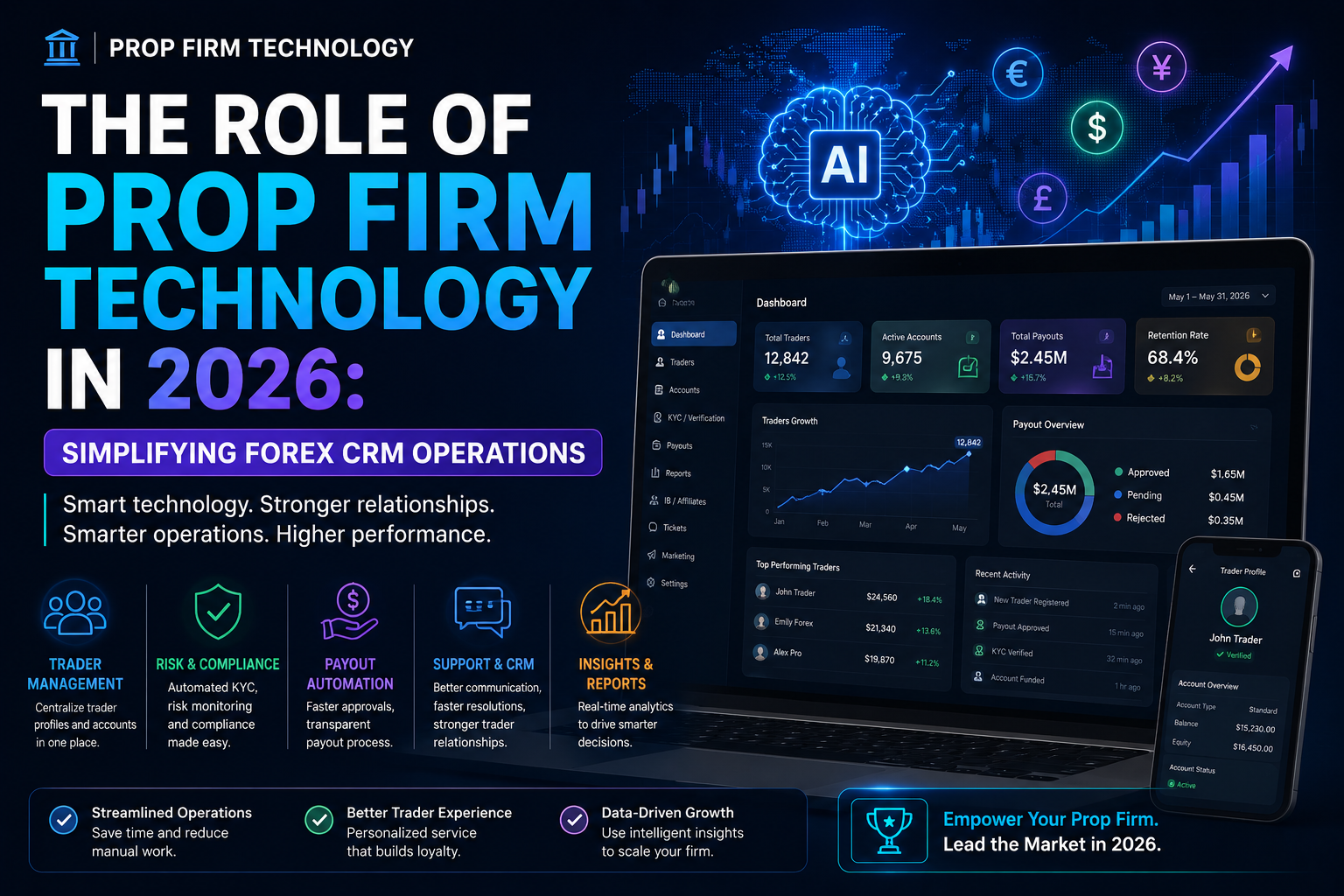
Prop firm technology simplifies forex CRM operations by connecting trader onboarding, challenge accounts, trading platforms, risk monitoring, KYC, payments, payouts and reporting in one operational system. For proprietary trading firms, this reduces manual administration, improves control and makes it possible to support more traders without expanding the operations team at the same rate.
By FXPropTech Editorial Team · Published July 24, 2026 · Updated July 24, 2026
Key takeaways
- A prop firm CRM is an operational back office, not only a customer database.
- Automation can connect purchases, account creation, KYC, risk checks and payouts.
- Real-time integrations help teams act on current trading and account information.
- Centralized records improve support, risk review, finance operations and auditability.
- AI can assist employees with summaries, case classification and operational analysis, while important decisions remain governed by firm rules and human oversight.
Contents
- What is prop firm technology?
- Why is a traditional CRM not enough?
- How does technology simplify daily operations?
- Which forex CRM workflows can be automated?
- What role does AI play in 2026?
- How should security and governance be handled?
- How do you choose a prop firm platform?
- How FXPropTech supports prop firm operators
- Frequently asked questions
What is prop firm technology?
Prop firm technology is the software infrastructure used to launch, operate and scale a proprietary trading firm. It connects the customer-facing trader experience with back-office systems that manage evaluations, trading accounts, risk rules, compliance checks, transactions and payouts.
A complete prop firm technology stack can include:
- A white-label website and trader dashboard
- A centralized prop firm admin CRM
- An evaluation engine for one-step, two-step, instant-funded and pay-later programs
- Automated trading-account creation and lifecycle management
- A real-time prop firm risk engine
- Trading platform, broker, liquidity and market-data integrations
- Payment-gateway and payout workflows
- KYC provider integrations
- Affiliate, coupon, email and notification automation
- Operational analytics, reports, APIs and webhooks
The objective is not merely to place several software tools beside one another. The objective is to make them exchange accurate information through a controlled workflow.
Why is a traditional CRM not enough for a forex prop firm?
A general CRM usually focuses on leads, contact details, sales pipelines and communication history. A forex prop firm CRM must also understand account-level trading conditions and the complete evaluation lifecycle.
| Operational requirement | Traditional CRM | Prop firm CRM |
|---|---|---|
| Customer profiles | Stores contact and sales information | Connects identity, purchases, accounts, KYC, risk and payouts |
| Evaluation phases | Usually requires custom fields or manual updates | Tracks challenge phase, targets, limits and completion status |
| Trading data | Not normally connected | Receives balances, equity, positions, trades and violations |
| Risk management | Handled outside the CRM | Links risk alerts and evidence to the correct account |
| Payout operations | Often managed through tickets and spreadsheets | Tracks eligibility, review, deductions, profit split and payment status |
| Account automation | Requires external development | Creates, upgrades, breaches, pauses and closes trading accounts |
Without purpose-built infrastructure, employees may need to move repeatedly between a payment processor, trading platform, KYC portal, spreadsheet, support desk and payout system. This increases the chance of inconsistent data and delays.
How does prop firm technology simplify daily CRM operations?
Modern prop firm software simplifies operations by creating one connected lifecycle for every trader. A purchase or account event can automatically update the relevant records, trigger the next action and notify the appropriate employee or trader.
Example of an automated trader lifecycle
- A trader registers and purchases an evaluation.
- The payment gateway confirms the transaction.
- The CRM applies the correct program, balance, platform and risk rules.
- A trading account is created and the credentials are delivered.
- Trading activity is sent to the monitoring and risk systems.
- The CRM updates challenge progress and account status.
- When the trader qualifies, the system starts the funded-account or review workflow.
- KYC and payout checks are triggered at the configured stage.
- Every important action is recorded for support, finance and risk teams.
This workflow reduces duplicate data entry because each department works from the same trader and account records.
One centralized view of the trader
A unified trader profile can bring together:
- Contact, country and registration information
- Purchased challenges and payment history
- Trading-platform logins and account phases
- Balance, equity, profit target and drawdown usage
- KYC status and review history
- Risk alerts and violation evidence
- Payout requests, decisions and completed payments
- Affiliate activity, coupons and referrals
- Support notes and administrative actions
When a trader contacts support, the team can investigate the complete case without requesting information from several departments.
Which forex CRM workflows can prop firm technology automate?
1. Trader onboarding and account creation
After a successful payment, the CRM can identify the purchased plan, create the correct trading account, apply its evaluation rules, store the login and send credentials to the trader. Automated onboarding improves delivery speed while reducing account-configuration errors.
2. Challenge and funded-account management
The CRM can track one-step, two-step, instant-funded and pay-later programs. It can display current phases, targets, loss limits, minimum trading days and account status, then route successful traders into the next operational stage.
3. Real-time risk monitoring
A connected risk engine can evaluate trading activity against configured rules such as maximum daily loss, maximum overall loss, profit targets, minimum trade duration, lot-size limits, news-trading windows and restricted strategies.
When a possible breach is detected, the system can:
- Create an alert with the relevant account and trade information
- Place the account into a review queue
- Restrict payout access while a case is reviewed
- Issue a warning or update the account status
- Apply an automated action when the firm’s rules allow it
- Preserve timestamps, calculations and evidence for later review
Learn more about configurable prop firm risk rules and real-time trade monitoring.
4. KYC and identity-verification workflows
KYC can be triggered at registration, before funded access, before the first payout, above a payout threshold or when an account requires additional review. Verification results can flow back into the CRM as approved, pending, rejected or manual-review statuses.
A connected KYC workflow can help the firm maintain consistent identity checks and preserve records of the verification process. The Financial Action Task Force explains that digital identity systems can support customer due diligence when they are assessed and used through an appropriate risk-based framework.
5. Payment and payout administration
Payment integrations can confirm purchases, record the amount and method, activate the correct product and update the trader’s transaction history. Payout workflows can check configured eligibility conditions before sending a request to finance or risk reviewers.
A structured payout process may verify:
- The payout cycle and minimum eligible date
- KYC completion
- Open or unresolved risk cases
- Minimum withdrawal amount
- The applicable profit-sharing percentage
- Approved deductions or adjustments
- The trader’s selected payout method
6. Affiliate and promotional management
The CRM can connect referral links, coupon codes, partner accounts, commissions and conversion reporting. This allows marketing and finance teams to work from the same attribution data.
7. Notifications and support operations
Automated notifications can be triggered by registration, successful payment, account delivery, phase completion, KYC updates, risk decisions, payout status and account closure. Support teams can also receive internal alerts when a case requires manual action.
8. Reporting and operational intelligence
Centralized data makes it easier to monitor revenue, challenge pass rates, funded-account activity, payout ratios, risk events, trader retention and platform performance. Reports should clearly define the source and calculation of each metric so decision-makers can interpret them correctly.
What role does AI play in prop firm CRM operations in 2026?
In 2026, AI is most useful as an operational assistant rather than an uncontrolled decision-maker. It can help employees understand cases faster, identify patterns and reduce repetitive administrative work.
Practical AI-assisted CRM functions can include:
- Summarizing a trader’s account, payment, KYC and support history
- Classifying incoming support requests by topic and urgency
- Drafting responses based on approved rules and recorded account data
- Explaining risk alerts in clear language for internal reviewers
- Highlighting missing information in payout or compliance cases
- Detecting unusual patterns across accounts for further investigation
- Producing daily or weekly operational summaries
- Helping managers search CRM records using natural-language questions
AI-generated recommendations should remain traceable to reliable source data. Account breaches, payout rejections and compliance actions should follow documented firm policies, with human review where the decision may materially affect a trader.
Why are platform integrations essential to a prop firm CRM?
A CRM cannot provide a reliable operational view unless it receives accurate information from the systems where payments, identity checks and trading activity occur.
Common integrations include:
- Trading platforms such as MetaTrader 5, cTrader, DXtrade, Match-Trader, TradeLocker, TradingView and Cleo
- Broker and liquidity infrastructure
- Payment gateways and cryptocurrency processors
- KYC and identity-verification providers
- Market-data and economic-calendar providers
- Email, support and marketing systems
- REST APIs and webhooks for custom applications
APIs and webhooks should use authentication, authorization, request validation, logging, rate controls and retry handling. The OWASP API Security Project provides a useful reference for common API risks, including broken authorization, authentication failures and unsafe consumption of third-party services.
How should security and governance be handled?
A prop firm CRM may contain identity records, trading-account information, payment history, payout decisions and administrative actions. Access must therefore be limited according to job responsibility and operational need.
Important controls include:
- Role-based permissions for support, finance, risk and administrators
- Multi-factor authentication for administrative users
- Encryption for data in transit and at rest
- API keys with restricted scopes and rotation procedures
- Audit logs for KYC, payout, account and rule changes
- Session, device and access monitoring
- Backups and tested recovery procedures
- Human approval for high-impact exceptions
NIST describes zero trust as an approach that avoids granting implicit trust based only on network location. For prop firm operators, this supports a practical principle: every employee and connected service should receive only the access required to perform its approved function.
What are the business benefits of a connected prop firm CRM?
Lower manual workload
Routine tasks such as account creation, status updates, notifications and eligibility checks can be automated, allowing employees to focus on exceptions and higher-value decisions.
Faster trader support
Support representatives can view the trader, account, payment, KYC and risk context from one system, reducing investigation time.
More consistent risk decisions
Configured rules can be applied to every relevant account using the same calculation logic, while reviewers retain access to supporting evidence.
Clearer payout processing
Eligibility checks, profit-share calculations, deductions, review status and payment records can be managed through a defined workflow.
Scalable operations
A connected platform can support increasing account volumes without requiring every operational task to be completed manually.
Improved trader transparency
A trader dashboard can show challenge progress, drawdown usage, trading days, KYC status, payout eligibility and account decisions using the same underlying CRM data.
How do you choose the right prop firm technology in 2026?
Operators should evaluate more than the visual appearance of a dashboard. The platform must support real operational workflows, integrations and controls.
Prop firm technology evaluation checklist
- CRM coverage: Can it manage traders, accounts, evaluations, KYC, payments, payouts and affiliates?
- Trading integrations: Does it support the platforms and broker infrastructure required by the firm?
- Risk flexibility: Can rules be configured by program, phase and funded-account type?
- Automation: Which events can create accounts, update statuses, send notifications or start reviews?
- Auditability: Are important actions, calculations and decisions logged?
- API access: Are secure APIs and webhooks available for custom integrations?
- Security: Does the platform provide appropriate authentication, permissions, monitoring and backups?
- Scalability: Can it support the firm’s expected account volume and multiple trading platforms?
- Customization: Can the firm change challenge models, rules, payout cycles, branding and workflows?
- Support: Is technical and operational assistance available during launch and after deployment?
How does FXPropTech simplify forex CRM operations?
FXPropTech is a Dubai-based prop firm technology and infrastructure provider. Its platform connects the core systems required to launch, operate and scale a proprietary trading firm.
FXPropTech solutions include:
- Admin CRM and back-office management
- White-label trader dashboards
- Evaluation and funded-account lifecycle management
- Automated risk management and violation monitoring
- Multi-platform trading integrations
- KYC provider integrations
- Payment-gateway and payout workflows
- Affiliate, coupon and notification tools
- APIs and webhooks
- Analytics and operational reporting
- Custom development and rule configuration
By connecting these functions, FXPropTech helps operators replace fragmented tools and repetitive manual processes with one coordinated operational environment.
Planning to launch or modernize a proprietary trading firm? Review the FXPropTech platform, compare prop firm technology plans or speak with the FXPropTech team.
Conclusion
Prop firm technology in 2026 is the operational infrastructure that connects the complete trader lifecycle. A specialized forex CRM can automate onboarding, centralize account data, apply risk workflows, manage KYC, structure payout reviews and give each department access to a consistent source of information.
The strongest systems do not automate blindly. They combine reliable integrations, configurable rules, clear evidence, audit logs and human oversight. This balance helps proprietary trading firms reduce administrative work while maintaining control as their trader base grows.
Frequently asked questions
What is prop firm technology?
Prop firm technology is the connected software infrastructure used to launch and operate a proprietary trading firm. It can include a forex CRM, trader dashboard, evaluation engine, risk controls, trading platform integrations, payments, KYC, payouts, affiliates, APIs and reporting.
What does a forex prop firm CRM manage?
A forex prop firm CRM manages trader profiles, challenge purchases, trading accounts, evaluation phases, KYC status, payments, payouts, risk alerts, affiliate activity, communications and administrative records from one back-office system.
How does prop firm technology simplify CRM operations?
It simplifies CRM operations by connecting payments, account creation, trading data, risk rules, KYC, payouts and notifications. Events are synchronized automatically, reducing spreadsheets, duplicate data entry, manual checks and delays between departments.
Can prop firm software automate KYC and payouts?
Yes. Prop firm software can trigger identity verification at registration, funded-account approval or payout request, update KYC status in the CRM, calculate eligible profit shares, route payout requests for review and maintain an audit trail of each decision.
How does a prop firm risk engine work with the CRM?
The risk engine receives trading data, evaluates it against account rules and sends the result to the CRM. The CRM can then display alerts, record evidence, restrict payouts, update account status or place a case into a manual review queue.
Which trading platforms can FXPropTech connect to?
FXPropTech supports integrations for widely used trading platforms including MetaTrader 5, cTrader, DXtrade, Match-Trader, TradeLocker, TradingView and Cleo, with multi-platform operations managed from a centralized admin CRM.
Is prop firm CRM software suitable for a startup?
Yes. A startup can use a white-label prop firm platform to launch with automated core workflows and then add account capacity, trading platforms, risk rules, payment methods, affiliates and reporting as the business grows.
Standards and further reading
- Financial Action Task Force: Guidance on Digital Identity
- NIST SP 800-207: Zero Trust Architecture
- OWASP API Security Project
Editorial note: This article is educational and describes technology and operational workflows for proprietary trading firms. Individual firms remain responsible for their legal, compliance, risk and payout policies.
Reviewed by the FXPropTech product and operations team. Last updated July 24, 2026.
FXPropTech — Prop firm technology, forex CRM, risk management and trading platform infrastructure.