
- What Is the Role of AI in Prop Firm Technology?
- Key Takeaways
- Table of Contents
- What Does AI Mean in Prop Firm Technology?
- 1. More Intelligent Prop Firm Risk Monitoring
- 2. Detecting Copy Trading and Multi-Account Abuse
- 3. Fraud Prevention and Account Security
- 4. Faster and More Consistent Payout Reviews
- 5. Improved Trader Support
- 6. Personalised Trader Dashboards
- 7. Better Business Intelligence for Prop Firm Operators
- 8. The Rise of AI Agents in Prop Firm Operations
- What AI Should Not Do in a Prop Firm
- Responsible AI Governance for Prop Firms
- Rules Engine vs AI: Why Prop Firms Need Both
- Business Benefits of AI in Prop Firm Technology
- The Future of Prop Firm Technology
- Frequently Asked Questions
- Authoritative Resources
- Build Smarter Prop Firm Infrastructure with FXPropTech
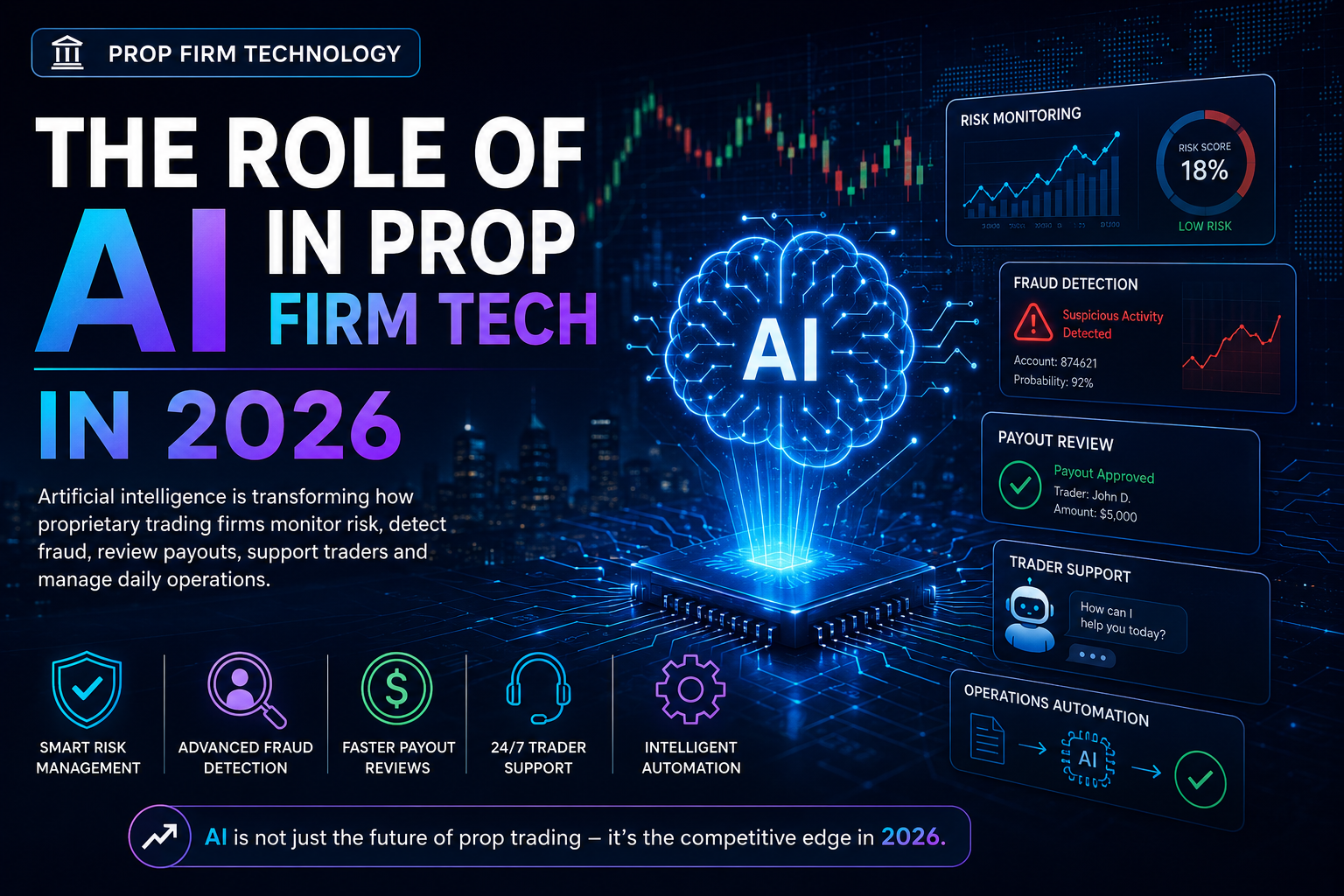
Artificial intelligence is transforming how proprietary trading firms monitor risk, detect fraud, review payouts, support traders and manage daily operations.
Published by FXPropTech on July 24, 2026
What Is the Role of AI in Prop Firm Technology?
AI helps prop firms analyse trader behaviour, detect unusual activity, reduce fraud, accelerate payout reviews and automate repetitive operational tasks. Its most valuable role is not predicting market direction. It is helping operators make faster, more consistent and better-informed decisions.
The strongest prop firm technology model in 2026 combines deterministic trading rules, AI-assisted analysis and human review. Fixed rules should calculate contractual violations, AI should identify patterns and prioritise cases, and authorised staff should make high-impact decisions.
Key Takeaways
- AI can improve prop firm risk monitoring without replacing transparent rule calculations.
- Behavioural analysis can help identify copy trading, coordinated hedging and account abuse.
- AI can combine trading, device, identity and payment data to strengthen fraud detection.
- Payout teams can use AI-generated case summaries to reduce manual review time.
- High-impact actions should remain explainable, auditable and subject to human approval.
- Connected prop firm infrastructure produces better AI results than disconnected tools.
Table of Contents
- What AI Means in Prop Firm Technology
- AI for Risk Monitoring
- Copy Trading and Multi-Account Detection
- Fraud Prevention and Account Security
- AI-Assisted Payout Reviews
- AI for Trader Support
- Personalised Trader Dashboards
- Business Intelligence for Operators
- AI Agents in Prop Firm Operations
- What AI Should Not Do
- Responsible AI Governance
- Rules Engine vs AI
- The Future of Prop Firm Technology
- Frequently Asked Questions
What Does AI Mean in Prop Firm Technology?
AI in prop firm technology refers to software that analyses operational and trading data, identifies patterns and assists with decisions across a proprietary trading firm’s infrastructure.
Common technologies include:
- Machine learning for behavioural pattern detection.
- Anomaly detection for identifying unusual trading or account activity.
- Natural language processing for support messages and document analysis.
- Generative AI for case summaries, explanations and internal assistance.
- Predictive analytics for estimating operational and behavioural risk.
Traditional prop firm software mainly depends on fixed conditions. For example, a risk engine can calculate whether a trader exceeded a 5% daily loss limit. The result is based on a transparent formula and clearly defined account data.
AI works differently. It can evaluate combinations of behaviour that may not breach one individual rule but may still indicate elevated risk, coordinated activity or possible abuse.
1. More Intelligent Prop Firm Risk Monitoring
Risk management is one of the most important uses of AI in prop firm software. Deterministic risk engines remain necessary for direct trading-rule calculations, including:
- Maximum daily loss.
- Maximum overall loss.
- Profit target completion.
- Minimum trading days.
- Minimum trade duration.
- Mandatory stop-loss rules.
- News-trading restrictions.
- Maximum single-trade loss.
AI adds a behavioural layer above these fixed controls. It can analyse whether an account’s trading style is changing in ways that may increase risk.
Examples of AI-assisted risk signals include:
- Sudden increases in lot size.
- Repeated one-sided exposure.
- Unusual concentration in one instrument.
- Rapid changes in trading behaviour after funding.
- Abnormal trading frequency.
- Correlated exposure across connected accounts.
- Repeated activity around high-impact economic events.
- Behaviour that differs substantially from the trader’s previous history.
The system can assign a review priority or behavioural risk score without automatically failing the account. This allows the risk team to focus on cases that require investigation instead of manually checking every account.
2. Detecting Copy Trading and Multi-Account Abuse
Basic copy-trading detection usually compares symbols, direction and execution time. More sophisticated users may attempt to avoid these checks by changing lot sizes, delaying trades or adjusting entry and exit levels.
AI can compare a broader set of signals, including:
- Entry and exit timing.
- Trade direction and sequence.
- Symbol combinations.
- Stop-loss and take-profit placement.
- Position-size ratios.
- Device and browser characteristics.
- IP address and geographic patterns.
- Trading-session behaviour.
- Similarity across complete trading histories.
AI can also help identify coordinated hedging, where related accounts open opposite positions to increase the probability that at least one account passes an evaluation.
Similarity alone does not prove misconduct. Major news events, popular trading sessions and common technical levels can naturally produce similar trades. AI alerts should therefore support an investigation rather than act as automatic proof.
3. Fraud Prevention and Account Security
Prop firms face more than trading risk. They also need to manage payment fraud, account sharing, identity manipulation, referral abuse and unauthorised account access.
AI can help detect:
- Multiple identities connected to the same device.
- Unusual login locations or rapid geographic changes.
- Repeated failed KYC attempts.
- Suspicious payment, refund or chargeback behaviour.
- Groups of accounts connected to the same referral source.
- Possible account sharing.
- Manipulated identity documents.
- Unexpected changes to payout details.
AI becomes especially useful when trading, payment, identity and device information are connected. A single event may look normal in isolation, while the combined data can reveal a meaningful pattern.
This is why an integrated prop firm CRM, risk engine and operational platform can provide more value than disconnected tools.
4. Faster and More Consistent Payout Reviews
Payout review is one of the most sensitive processes in a proprietary trading firm. Before approving a withdrawal, the team may need to check:
- Account profitability.
- Daily and overall drawdown compliance.
- News-trading activity.
- Copy-trading or multi-account alerts.
- Minimum trading-day requirements.
- Trade-duration rules.
- KYC status.
- Payment ownership.
- Previous payout history.
- Open risk investigations.
AI can collect this information and prepare a structured payout case summary showing the requested amount, profit split, rule-related deductions, relevant alerts and recommended review priority.
The final decision should remain with an authorised administrator. AI should organise evidence and reduce review time, not reject payouts through an unexplained score.
5. Improved Trader Support
Prop firm support teams repeatedly answer questions about payout eligibility, drawdown calculations, failed accounts, news trading, overnight positions and account activation.
An AI assistant connected to the firm’s actual rules and account data can provide a more accurate answer than a general chatbot.
For example, instead of giving a generic explanation of minimum trading days, the assistant could state that a trader has completed four of the five required days and needs one more qualifying day before becoming eligible.
AI can also help support teams by:
- Categorising incoming tickets.
- Identifying urgent account-access or payment issues.
- Translating support conversations.
- Summarising long email threads.
- Suggesting responses to agents.
- Detecting recurring complaints.
- Routing complex cases to the correct department.
The assistant must retrieve verified information from the prop firm’s own systems. It should not invent trading rules, payout dates or account statuses.
6. Personalised Trader Dashboards
Most prop firm dashboards show similar information to every trader. AI can make the experience more relevant by highlighting the metrics that matter most to the individual account.
Examples include:
- Personalised drawdown warnings.
- Trading-behaviour summaries.
- Challenge-progress explanations.
- Concentration and exposure warnings.
- Payout-readiness indicators.
- Educational guidance based on repeated mistakes.
A trader approaching the daily loss limit may receive a stronger warning, while a trader close to passing an evaluation may see the exact remaining profit target and trading-day requirements.
These features should be presented as account and risk-management guidance, not as investment advice or guaranteed trading predictions.
7. Better Business Intelligence for Prop Firm Operators
A modern prop firm produces data across sales, evaluations, affiliates, payments, trading, support, payouts and risk management. AI can connect these datasets and help operators understand the business more clearly.
Management teams can use AI-assisted analytics to answer questions such as:
- Which challenge plans attract more sustainable traders?
- Which marketing channels create the highest refund or chargeback rates?
- Which affiliates produce the most payout-qualified accounts?
- Where do traders abandon the registration or payment process?
- Which account sizes create the highest operational exposure?
- Which rules generate the most support complaints?
- How long does the average payout review take?
- Which payment providers experience the most failures?
Natural-language analytics can help managers access useful information without manually building reports, but important decisions should still be validated against the source data.
8. The Rise of AI Agents in Prop Firm Operations
In 2026, financial technology is moving beyond standalone chatbots toward AI agents that can complete a sequence of approved operational steps.
An AI payout-review agent could:
- Retrieve the trader’s account data.
- Check the payout-cycle requirements.
- Review risk and trading alerts.
- Confirm KYC status.
- Calculate the applicable profit split.
- Create an internal case summary.
- Assign the case to an administrator.
AI agents should never have unrestricted access. Each agent should operate with defined permissions, approval requirements, action limits, human override controls and complete audit logs.
What AI Should Not Do in a Prop Firm
AI can improve prop firm operations, but high-impact actions should not be delegated without transparent controls.
A prop firm should avoid allowing AI to:
- Close accounts without an explainable rule or review.
- Reject payouts based only on an opaque score.
- Change trading conditions without authorisation.
- Access complete customer datasets unnecessarily.
- Provide guaranteed market predictions.
- Make legal or compliance conclusions without expert review.
- Send sensitive data to unapproved external AI systems.
- Automatically accuse traders of prohibited activity.
The purpose of AI should be to improve evidence, prioritisation and operational consistency while preserving accountability.
Responsible AI Governance for Prop Firms
Responsible AI adoption requires more than adding a chatbot to an admin panel. A prop firm should create an internal governance framework covering the full lifecycle of every AI system.
Clear Ownership
Each AI system should have an accountable business owner who approves its use, monitors its performance and manages failures or incorrect outputs.
Data Protection
Only the minimum data required for the task should be shared with the model. Personally identifiable information, payment data and trading records should be protected through encryption, restricted access and retention controls.
Testing and Validation
Models should be tested before release and monitored after deployment. Trading behaviour changes over time, so detection models may need recalibration.
Explainable Outputs
Risk alerts should identify the evidence behind the result. An administrator should be able to understand why the account was flagged.
Human Oversight
Payout rejection, account termination and fraud accusations should require human review and approval.
Audit Trails
The platform should record the model version, input data, generated output, administrator decision and final action.
Third-Party Vendor Management
Prop firms should know where external AI providers process data, how long it is retained and whether it is used to train other models.
Rules Engine vs AI: Why Prop Firms Need Both
| Technology Layer | Primary Purpose | Example |
|---|---|---|
| Deterministic rules engine | Calculate contractual conditions with transparent formulas. | Determine whether the trader exceeded the maximum daily loss. |
| AI-assisted analysis | Identify unusual behaviour, patterns and relationships. | Flag a sudden behavioural change across several related accounts. |
| Human review | Evaluate context and make high-impact decisions. | Approve or reject a payout after reviewing the complete evidence. |
The rules engine provides certainty. AI provides context. Human reviewers provide accountability.
A strong prop firm technology platform should combine all three rather than relying entirely on one system.
Business Benefits of AI in Prop Firm Technology
The competitive advantage does not come from simply describing a platform as “AI-powered.” It comes from measurable operational improvements.
- Faster payout reviews.
- Lower fraud and chargeback exposure.
- More accurate risk investigations.
- Shorter support-response times.
- Fewer false-positive violations.
- Better trader communication.
- More efficient internal operations.
- Stronger auditability and governance.
The Future of Prop Firm Technology
AI is becoming an important layer within prop firm infrastructure, but it should not become the entire infrastructure.
The foundation must still include reliable account provisioning, real-time trading data, deterministic risk calculations, secure payments, identity verification, payout management and complete audit records.
AI becomes valuable when it operates above that foundation and helps risk, compliance, support and management teams interpret information more efficiently.
At FXPropTech, we believe the future of prop firm technology will be built around connected infrastructure: CRM, trading-platform integrations, risk management, KYC, payments, payouts and operational analytics working through one central system.
AI can make this infrastructure faster and more intelligent. Transparent rules, responsible governance and human accountability will make it trustworthy.
Frequently Asked Questions
How is AI used in prop firms?
AI is used in prop firms to support risk monitoring, copy-trading detection, fraud prevention, payout reviews, trader support, account security and business analytics.
Can AI automatically detect prop firm rule violations?
AI can identify unusual patterns and prioritise accounts for investigation. Contractual limits such as daily loss and overall drawdown should normally be calculated with deterministic rules. High-impact decisions should include human review.
Can AI detect copy trading between prop firm accounts?
AI can compare trade timing, direction, symbols, lot-size ratios, stop-loss placement, devices, IP patterns and complete trading sequences. Similarity should be treated as evidence for investigation rather than automatic proof.
Will AI replace prop firm risk managers?
AI is more likely to assist risk managers than replace them. It can prioritise cases, summarise activity and detect patterns, while humans remain responsible for contextual and high-impact decisions.
Is AI safe for prop firm trader data?
AI can be used safely when the platform applies data minimisation, encryption, access restrictions, audit logs, vendor controls and human oversight. Sensitive customer data should not be shared with unapproved public AI tools.
What is the best AI architecture for a prop firm?
The strongest architecture combines deterministic rule calculations, AI-assisted pattern detection, restricted permissions, human review and complete audit trails.
Authoritative Resources
- NIST AI Risk Management Framework
- European Commission: EU AI Act
- Financial Stability Board: Artificial Intelligence and Machine Learning
- European Banking Authority: Artificial Intelligence in Financial Services
Build Smarter Prop Firm Infrastructure with FXPropTech
AI is only effective when it has access to accurate, connected and properly governed data.
FXPropTech provides the core technology required to launch and operate a modern proprietary trading firm, including prop firm CRM, trading-platform integration, automated risk management, KYC workflows, payment integrations, payout management and administrator controls.
Contact FXPropTech to discuss your prop firm technology requirements.
About FXPropTech: FXPropTech provides technology infrastructure for proprietary trading firms, including CRM, risk automation, trading-platform integrations, KYC, payments and payout workflows.
This article is for general informational purposes and does not constitute financial, investment or legal advice.