
- Answer-First Summary
- What Is MetaTrader 5?
- What Is Match-Trader?
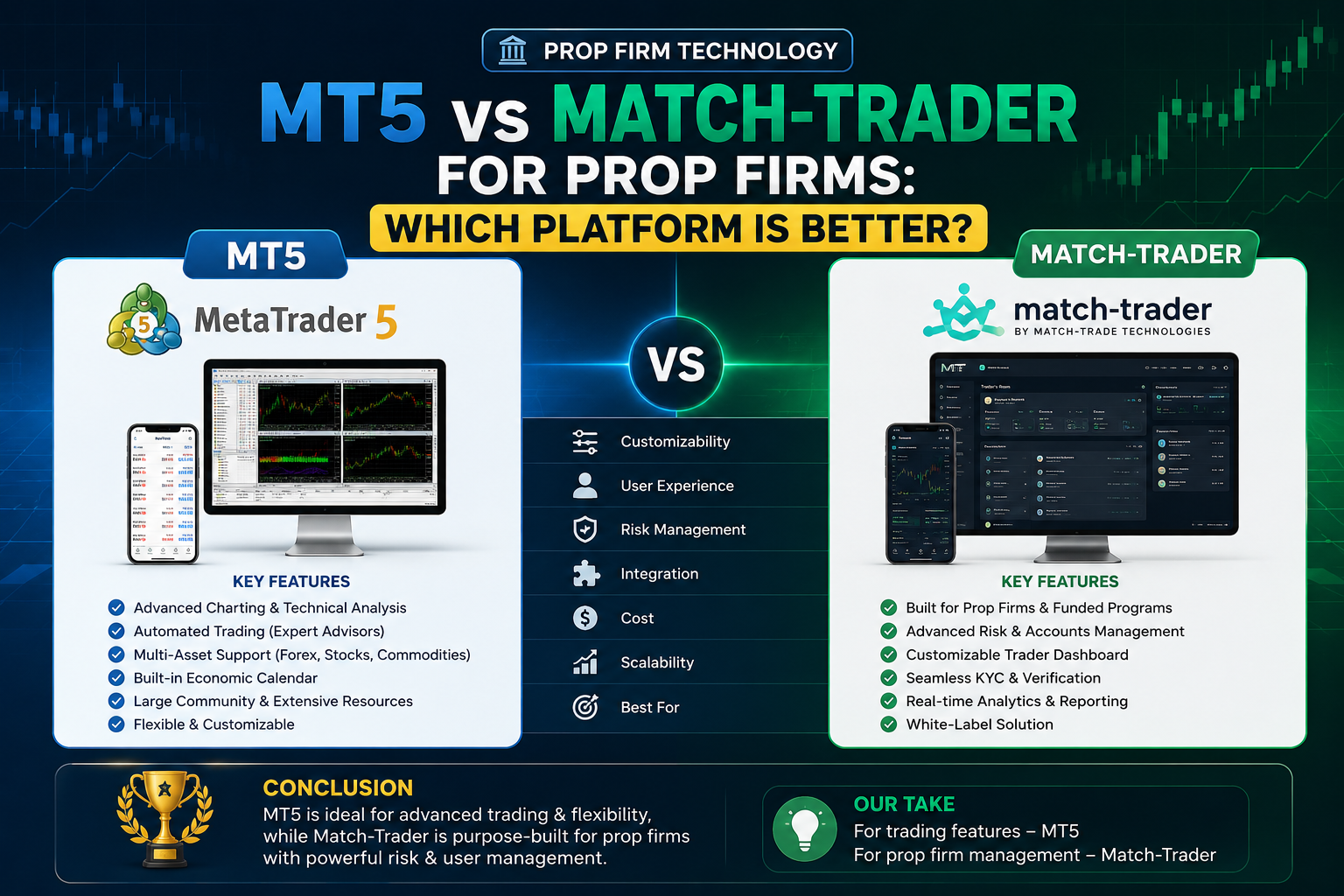
- MT5 vs Match-Trader: Quick Comparison
- 1. Trader Recognition and Trust
- 2. Platform Setup and Launch Speed
- 3. Desktop, Web and Mobile Experience
- 4. Automated Trading and Expert Advisors
- 5. Branding and Trader Experience
- 6. CRM and Account Provisioning
- 7. Risk Management and Rule Enforcement
- 8. Daily Drawdown Calculations
- 9. Reporting and Administrative Control
- 10. Cost Considerations
- 11. Scalability
- 12. Which Platform Is Better for a New Prop Firm?
- 13. Which Platform Is Better for an Established Prop Firm?
- 14. Can a Prop Firm Offer Both MT5 and Match-Trader?
- MT5 Is Usually Better When
- Match-Trader Is Usually Better When
- Platform Selection Checklist for Prop Firm Founders
- The Trading Platform Is Only One Part of the Prop Firm
- Final Verdict
- Frequently Asked Questions
- Is MT5 good for prop firms?
- Is Match-Trader suitable for prop firms?
- Is Match-Trader cheaper than MT5?
- Can traders use Expert Advisors on Match-Trader?
- Does MT5 automatically monitor prop firm rules?
- Can a prop firm use MT5 and Match-Trader together?
- Which platform is better for beginners?
- Which platform is better for experienced traders?
- Build a Multi-Platform Prop Firm with FXPropTech
Choosing between MetaTrader 5 and Match-Trader is one of the most important technology decisions a new prop firm will make.
Published by FXPropTech
The trading platform affects much more than charting and order execution. It influences launch costs, trader acquisition, account provisioning, risk monitoring, branding, mobile experience, broker connectivity, operational control, and the firm’s ability to scale.
MetaTrader 5, commonly known as MT5, remains one of the most recognised trading platforms in the global retail trading industry. Match-Trader offers a more modern, web-focused experience designed around simplified access, custom branding, and faster platform deployment.
Neither platform is automatically the best choice for every prop firm. The right option depends on your target market, technology budget, launch timeline, operating model, and long-term growth strategy.
Answer-First Summary
MT5 is generally better for established prop firms that want strong trader recognition, advanced desktop trading tools, broad market familiarity, and access to a large trading ecosystem.
Match-Trader is often better for new or growing prop firms that want a modern browser-based experience, easier onboarding, flexible branding, and a potentially faster route to market.
However, the trading platform alone does not operate a prop firm. Both MT5 and Match-Trader must be connected to a complete prop firm infrastructure that handles account creation, trading rules, drawdown monitoring, KYC, payments, payouts, affiliate tracking, risk detection, and trader dashboards.
What Is MetaTrader 5?
MetaTrader 5 is a multi-asset trading platform developed by MetaQuotes. It is widely used by brokers, professional traders, retail traders, and proprietary trading firms.
MT5 provides desktop, web, and mobile trading applications. It supports advanced charting, automated trading through Expert Advisors, multiple order types, technical indicators, market depth, and algorithmic strategy testing.
For prop firms, MT5 is typically connected to a broker or liquidity infrastructure. The prop firm’s CRM and risk engine then use trading APIs to create accounts, retrieve balances, track equity, monitor trades, and enforce challenge rules.
Main advantages of MT5
MT5 offers strong brand recognition among forex and CFD traders. Many traders already understand the interface and have existing trading strategies, indicators, and Expert Advisors built for the MetaTrader ecosystem.
It is especially attractive to prop firms targeting experienced traders who expect advanced desktop tools and algorithmic trading support.
MT5 also has an established technology ecosystem that includes brokers, liquidity providers, bridge providers, hosting companies, risk systems, trading tools, and third-party integrations.
Main limitations of MT5
Running MT5 infrastructure can be more complex than launching a web-first trading platform.
The prop firm may need to coordinate with a broker, white-label provider, server provider, bridge provider, or technology vendor. Commercial terms, technical access, API permissions, and hosting requirements can vary considerably between providers.
MT5 can also provide less flexibility over the core trading interface because the platform experience is controlled primarily by MetaQuotes.
A prop firm can customise branding, account types, symbols, leverage, groups, and trading conditions, but it cannot completely redesign the terminal experience.
What Is Match-Trader?
Match-Trader is a multi-asset trading platform developed by Match-Trade Technologies. It has become popular among brokers and prop firms looking for a browser-based, mobile-friendly trading experience.
The platform allows traders to access their accounts through a web browser without installing a desktop application. Depending on the provider’s setup, it may also include mobile access and integrated client-area functionality.
Match-Trader focuses on simplicity, accessibility, modern design, and streamlined onboarding.
Main advantages of Match-Trader
Match-Trader offers a modern interface that is generally easier for new traders to learn.
Because it is web-based, traders can access the platform quickly without downloading and configuring a desktop terminal. This can reduce friction between purchasing a challenge and placing the first trade.
The platform can also provide more branding flexibility than a traditional MetaTrader installation. Prop firms may be able to create a more consistent experience between their website, trader dashboard, and trading platform.
This makes Match-Trader attractive to startups, mobile-first prop firms, and companies targeting newer traders.
Main limitations of Match-Trader
Match-Trader does not have the same level of global trader recognition as MT5.
Some experienced forex traders may prefer MetaTrader because they already use MT5 indicators, Expert Advisors, scripts, templates, and trading workflows.
The availability of specific instruments, execution models, API capabilities, automation features, and broker connections may also depend on the selected Match-Trader provider.
Prop firms should confirm all technical requirements before signing a platform agreement.
MT5 vs Match-Trader: Quick Comparison
| Category | MT5 | Match-Trader |
|---|---|---|
| Trader recognition | Very high | Growing |
| User experience | Advanced and feature-rich | Modern and simplified |
| Desktop trading | Strong | Primarily web-focused |
| Browser access | Available | Core platform strength |
| Mobile experience | Established mobile apps | Mobile-friendly experience |
| Algorithmic trading | Strong Expert Advisor ecosystem | Depends on platform configuration |
| Custom branding | Moderate | Generally more flexible |
| Learning curve | Higher for beginners | Easier for new traders |
| Technology setup | Can be more complex | Often simpler to launch |
| Third-party ecosystem | Very large | Smaller but expanding |
| Experienced trader appeal | Very strong | Moderate |
| Startup suitability | Suitable with the right budget | Strong option |
| Prop firm integrations | Requires CRM and API integration | Requires CRM and API integration |
| Best fit | Established and professional trading audience | Modern, web-first prop firm |
Commercial terms and available features can differ based on the broker, platform provider, white-label arrangement, liquidity setup, and API access.
1. Trader Recognition and Trust
MT5 has a major advantage in platform familiarity.
A large number of forex traders already know how to use MetaTrader. They understand how to open and close trades, install indicators, run Expert Advisors, manage charts, and monitor account history.
This reduces the amount of education required when a trader joins a prop firm.
For prop firms targeting professional traders, automated traders, or users migrating from other evaluation firms, MT5 can improve conversion because the platform is already familiar.
Match-Trader may require some traders to learn a new interface. However, its simpler design can be an advantage when targeting beginners, mobile-first users, or traders who prefer a clean browser-based platform.
Winner for trader familiarity: MT5
Winner for beginner accessibility: Match-Trader
2. Platform Setup and Launch Speed
Launching an MT5-based prop firm can involve several parties.
Depending on the business model, the firm may need:
- MT5 access through a broker or white-label provider
- Trading groups and symbol configuration
- Manager API or reporting API access
- Server or hosting arrangements
- Bridge and liquidity configuration
- CRM integration
- Automated account provisioning
- Risk monitoring integration
This can increase both launch complexity and dependency on external providers.
Match-Trader is often positioned as a more integrated and deployment-friendly solution. The exact process still depends on the selected provider, but the platform may offer a more direct path to launching a branded trading environment.
A new prop firm that prioritises speed may find Match-Trader easier to deploy.
Winner for simplified launch: Match-Trader
3. Desktop, Web and Mobile Experience
MT5 offers a mature desktop application with advanced charting, strategy testing, multiple windows, custom indicators, scripts, and Expert Advisors.
For traders who spend several hours analysing charts or running automated strategies, the desktop terminal remains a major advantage.
Match-Trader focuses more heavily on browser accessibility. Traders can log in from different devices without installing a terminal.
This is useful for traders who want quick access from a laptop, tablet, or mobile browser.
The best option depends on your audience. A professional forex trader may prefer MT5’s desktop environment. A newer trader who values convenience may prefer Match-Trader’s web interface.
Winner for advanced desktop trading: MT5
Winner for browser-first access: Match-Trader
4. Automated Trading and Expert Advisors
MT5 has one of the largest automated trading ecosystems in retail trading.
Traders can build or purchase Expert Advisors, indicators, scripts, and trading utilities using the MQL5 environment.
For prop firms that allow automated trading, this can attract algorithmic traders. However, it also creates additional risk-management requirements.
The firm must be able to detect:
- High-frequency trading
- Tick scalping
- Latency exploitation
- Prohibited Expert Advisors
- Copy trading
- Coordinated account activity
- News-based execution abuse
- Extremely short trade durations
Match-Trader may support automation or third-party integrations depending on the provider’s configuration, but it does not have the same established Expert Advisor ecosystem as MT5.
Winner for algorithmic trading: MT5
5. Branding and Trader Experience
Brand consistency is becoming increasingly important in the prop firm industry.
Traders expect the website, checkout, client dashboard, trading terminal, certificates, emails, and support experience to feel like one connected product.
MT5 allows prop firms to apply logos, server names, group settings, and certain branding elements. However, the core interface remains recognisably MetaTrader.
Match-Trader can provide a more customised, web-native experience. It may be easier to align the trading platform with the firm’s website and CRM design.
For prop firms building a strong consumer brand, this flexibility can be valuable.
Winner for brand flexibility: Match-Trader
6. CRM and Account Provisioning
Neither MT5 nor Match-Trader should be considered a complete prop firm solution by itself.
The trading platform handles trading activity. The prop firm CRM must manage the business operations surrounding that activity.
A properly integrated CRM should automatically:
- Process the trader’s payment.
- Create the correct challenge account.
- Apply the account size and leverage.
- Assign the correct trading rules.
- Display credentials in the trader dashboard.
- Monitor the account’s balance and equity.
- Detect rule violations.
- Move successful traders to the next phase.
- Manage funded-account eligibility.
- Process payout requests.
Without this integration, staff members may need to create accounts, update challenge phases, and review violations manually.
FXPropTech can connect the trading platform to the prop firm’s website, CRM, admin panel, trader dashboard, risk engine, KYC provider, payment gateways, affiliate system, and payout workflow.
7. Risk Management and Rule Enforcement
The trading platform provides trading data, but the risk engine determines how that data is interpreted.
A prop firm risk engine should continuously monitor:
- Maximum daily loss
- Maximum overall loss
- Profit target
- Minimum trading days
- Trading consistency
- Single-trade loss
- Floating losses
- Stop-loss requirements
- Minimum trade duration
- News trading
- Copy trading
- Hedging across accounts
- High-frequency trading
- Martingale behaviour
- Lot-size spikes
- One-sided trading
- Shared IP or device activity
- Coordinated activity between traders
This applies to both MT5 and Match-Trader.
The quality of the prop firm’s risk system is often more important than the choice between the two trading terminals.
A modern risk engine should calculate breaches in real time or near real time, preserve supporting evidence, reduce false positives, and route uncertain cases to an administrator for review.
8. Daily Drawdown Calculations
Daily drawdown is one of the most important rules in a prop firm challenge.
However, prop firms do not all calculate it in the same way.
The daily loss limit may be based on:
- Starting balance at the beginning of the day
- Starting equity at the beginning of the day
- The higher of balance or equity
- Initial account balance
- Realised losses only
- Realised and floating losses
- A fixed server reset time
The trading platform supplies the account and trade data, but the CRM and risk engine must apply the firm’s specific rule.
Prop firms should confirm that their technology provider can reproduce the exact daily-loss logic shown in their terms and conditions.
Incorrect drawdown calculations can lead to trader complaints, false breaches, payout disputes, and reputational damage.
9. Reporting and Administrative Control
MT5 can provide detailed trade and account information through manager-level tools and API integrations.
Administrators may be able to review:
- Open positions
- Closed trades
- Balance operations
- Equity
- Margin
- Trading groups
- Symbols
- Login history
- Trade comments
- Order execution information
Match-Trader also offers administrative and integration capabilities, but the exact information available depends on the provider and API package.
Before choosing either platform, the prop firm should request a complete demonstration of the administrative environment.
The team should test whether it can:
- Create and disable accounts
- Change leverage
- Reset passwords
- Update account groups
- Retrieve live equity
- Read open and closed positions
- Export trade history
- Detect trading-rule violations
- Suspend trading during payout review
- Maintain a complete audit trail
10. Cost Considerations
The cost of launching a prop firm cannot be evaluated by looking at the trading platform alone.
The complete technology budget may include:
- Trading platform access
- Broker or liquidity arrangement
- Server and hosting fees
- CRM licensing
- Risk-management software
- Website development
- Payment gateway fees
- KYC verification
- Email and notification services
- Affiliate tracking
- Support tools
- Maintenance and technical integration
MT5 may require a higher infrastructure and integration budget, particularly when the firm needs advanced API access and professional hosting.
Match-Trader may offer a more accessible entry point for certain startup models, but commercial terms vary between providers.
Prop firms should compare the total monthly operating cost rather than only the platform licence or setup fee.
11. Scalability
MT5 is suitable for large prop firms that manage high account volumes across multiple groups, instruments, brokers, and regions.
Its large ecosystem can make it easier to find experienced technology partners and trading specialists.
Match-Trader can also support growing firms, particularly those operating through a modern web-based infrastructure.
However, scalability depends on more than account capacity.
A scalable prop firm must also be able to handle:
- Thousands of account creations
- Frequent balance and equity updates
- Real-time breach detection
- Large affiliate networks
- Payment reconciliation
- Payout verification
- KYC reviews
- Tournament leaderboards
- Customer-support requests
- Multi-language dashboards
- Multiple trading platforms
The CRM and risk-engine architecture should be evaluated alongside the trading platform.
12. Which Platform Is Better for a New Prop Firm?
Match-Trader may be a better choice for a new prop firm when the priorities are:
- Faster launch
- Modern user experience
- Browser-based trading
- Strong brand consistency
- Simpler onboarding
- Lower operational complexity
- Mobile-first trader acquisition
MT5 may be better for a startup when the target audience already expects MetaTrader or when the firm wants to attract experienced forex and algorithmic traders.
The startup must still ensure that it has sufficient budget for platform access, CRM integration, API connectivity, risk monitoring, and ongoing operations.
13. Which Platform Is Better for an Established Prop Firm?
MT5 is often a strong option for established firms because of its market recognition, professional trading tools, algorithmic ecosystem, and familiarity among experienced traders.
An established prop firm may already have:
- Existing MT5 traders
- Broker relationships
- Automated risk systems
- Manager API integrations
- Multiple trading groups
- Established operational teams
Migrating completely to another platform may create unnecessary friction.
However, adding Match-Trader as a second platform can help the firm attract a different type of customer.
A multi-platform model allows traders to select the platform that matches their trading style.
14. Can a Prop Firm Offer Both MT5 and Match-Trader?
Yes. A prop firm can offer multiple trading platforms, provided its CRM and risk engine support them.
In a multi-platform architecture, the CRM acts as the central control layer.
The trader can purchase a challenge and choose MT5 or Match-Trader. The system then creates the account on the selected platform while applying the same challenge conditions.
The dashboard should display performance consistently regardless of the trading platform.
This requires a standardised data model for:
- Balance
- Equity
- Profit
- Daily drawdown
- Overall drawdown
- Trading days
- Open positions
- Closed positions
- Challenge status
- Payout eligibility
- Risk violations
A multi-platform strategy reduces dependency on a single vendor and gives traders more choice. However, it also increases integration, testing, support, and monitoring requirements.
MT5 Is Usually Better When
- Your target audience already uses MetaTrader.
- You want to attract professional forex traders.
- Expert Advisors and algorithmic trading are important.
- You require advanced desktop trading tools.
- You have the budget for infrastructure and integration.
- You want access to a large third-party ecosystem.
- Your broker or liquidity partner already supports MT5.
Match-Trader Is Usually Better When
- You want a modern browser-based trading experience.
- Your target audience includes newer traders.
- You want to minimise platform onboarding friction.
- Brand consistency is important.
- You want a potentially faster route to market.
- Your business is mobile-first.
- You prefer a streamlined platform environment.
Platform Selection Checklist for Prop Firm Founders
Before choosing MT5 or Match-Trader, ask each provider the following questions:
Trading access
- Does the platform support web, desktop, Android, and iOS access?
- Which asset classes and symbols are available?
- Can leverage be configured by account group?
- Are Expert Advisors or automated strategies supported?
API and integration
- Can accounts be created automatically through an API?
- Can the CRM retrieve live balance and equity?
- Are open positions available in real time?
- Can the platform disable trading automatically?
- Are complete trade histories and timestamps available?
Risk management
- Can the risk engine monitor floating losses?
- Can it calculate daily drawdown based on the firm’s exact rules?
- Can it detect copy trading and hedging across accounts?
- Can it identify HFT, scalping, martingale, and lot-size abuse?
- Can administrators review evidence before applying a breach?
Operations
- How are funded accounts created?
- Can trading be suspended during payout review?
- Can account credentials be reset automatically?
- Is there an audit log for administrative actions?
- What happens if the trading server or API becomes unavailable?
Commercial terms
- What are the setup fees?
- What are the monthly platform fees?
- Are there account-volume charges?
- Are API fees included?
- Are hosting, server, bridge, and support costs included?
- Is there a minimum contract period?
The Trading Platform Is Only One Part of the Prop Firm
A successful prop firm requires a complete operational ecosystem.
The core technology stack should include:
Trader CRM
The trader CRM manages registration, purchases, challenge accounts, performance data, certificates, payouts, support tickets, affiliate links, and account history.
Admin panel
The admin panel allows the prop firm team to manage traders, accounts, plans, payments, KYC reviews, violations, payouts, trading rules, coupons, and affiliate commissions.
Real-time risk engine
The risk engine monitors challenge rules and identifies suspicious trading behaviour across single and multiple accounts.
Payment integrations
The platform should support card, cryptocurrency, and alternative payment providers while automatically reconciling successful and failed payments.
KYC system
KYC verification should be integrated into the funded-account and payout workflow.
Payout workflow
A payout system should calculate the trader’s profit split, deductions, eligibility date, risk-review status, and final approved amount.
Affiliate management
The affiliate system should track links, registrations, purchases, commissions, withdrawals, and campaign performance.
Tournament infrastructure
Prop firms that offer competitions need registration controls, account limits, leaderboards, prize distribution, disqualification rules, rejoin logic, and real-time ranking updates.
Final Verdict
There is no universal winner in the MT5 vs Match-Trader comparison.
MT5 remains a strong choice for prop firms that want platform recognition, professional desktop tools, automated trading capabilities, and access to an established trading ecosystem.
Match-Trader is an attractive option for firms that prioritise modern design, browser accessibility, branding, simplified onboarding, and faster deployment.
For many prop firms, the best long-term strategy may be to build a platform-independent CRM and risk engine that can support both.
This allows the business to add or replace trading platforms without rebuilding its entire operational system.
The final decision should be based on the complete business model—not only on the trading interface.
Frequently Asked Questions
Is MT5 good for prop firms?
Yes. MT5 is widely used by prop firms because it offers advanced trading tools, strong trader familiarity, algorithmic trading support, and a large technology ecosystem. It still requires CRM, API, and risk-management integrations.
Is Match-Trader suitable for prop firms?
Yes. Match-Trader is suitable for prop firms that want a modern, web-based trading platform with simplified onboarding and flexible branding.
Is Match-Trader cheaper than MT5?
Match-Trader may offer a more accessible setup for some prop-firm models, but pricing depends on the provider, account volume, API access, broker arrangement, hosting, and commercial agreement. Firms should compare total operating costs.
Can traders use Expert Advisors on Match-Trader?
Automation capabilities depend on the provider and platform configuration. Prop firms should confirm supported automation features before launching. MT5 has a more established Expert Advisor ecosystem.
Does MT5 automatically monitor prop firm rules?
No. MT5 provides account and trading data, but a separate CRM or risk engine is normally required to calculate daily loss, overall drawdown, profit targets, trading days, and prohibited-strategy violations.
Can a prop firm use MT5 and Match-Trader together?
Yes. A prop firm can offer both platforms when its CRM and risk infrastructure support multi-platform account provisioning, data normalisation, rule monitoring, and trader reporting.
Which platform is better for beginners?
Match-Trader may be easier for beginners because of its modern browser-based interface and simplified user experience.
Which platform is better for experienced traders?
MT5 is often preferred by experienced forex and algorithmic traders because of its desktop tools, indicators, scripts, strategy tester, and Expert Advisor ecosystem.
Build a Multi-Platform Prop Firm with FXPropTech
FXPropTech provides the technology required to launch and operate a modern proprietary trading firm.
Our infrastructure can include:
- Branded prop firm website
- Trader CRM
- Administrative dashboard
- Automated trading-account creation
- Real-time drawdown monitoring
- Multi-account risk detection
- KYC integration
- Payment gateway integration
- Affiliate management
- Payout workflows
- Tournament management
- Multi-platform connectivity
- MT5 and alternative platform integrations
Whether you choose MT5, Match-Trader, or a multi-platform model, your trading platform must be supported by a reliable CRM and risk-management infrastructure.